

What Belongs in Your FranDev Sales Room?
The Sales Room you invite qualified Prospective Franchisees to is the first real proof they will see of your “proven system”. Here's what it should include.

In This Lab Report
Your candidates need more than just your Brand presentation and the FDD to evaluation your franchise. A Sales Room provides a “home base” that anchors their expectations, builds their trust, and really demonstrates that you are running a system. It helps them understand the process, it gives them one place to grab materials to show their partner, mentors or advisors, and their Franchise Attorney. Here’s where you should start when evaluating or planning the content for that experience.
Why This Matters
The diligence process for most Brands runs 90 days +/- 20. And it involves multiple people and you don’t see or talk to them all. And, on top of that, the Prospective Franchisees might be considering multiple Brands at the same or might have just rejected 1 or more brands. If they were sourced by Brokers, they’ve seem details on at least 3-5 Brands. You need to stand out from the pack.
What a Sales Room Should Contain
A FranDev Sales Room is a guided, stage-based deal room that keeps Candidates oriented through a high-stakes decision. A good one does four jobs at once:
It sets expectations and timing across every stage
It helps Candidates self-educate without getting lost
It reinforces trust and momentum over a long cycle
It houses the documents specific to each Candidate as the deal moves
A great Sales Room (in the Lab we recommend the Arrows platform) also provides native analytics and reporting on the Candidate’s activity so you know if they’re engaged and can automate outreach if they haven’t checked the room ahead of your next call.
The 8 Elements
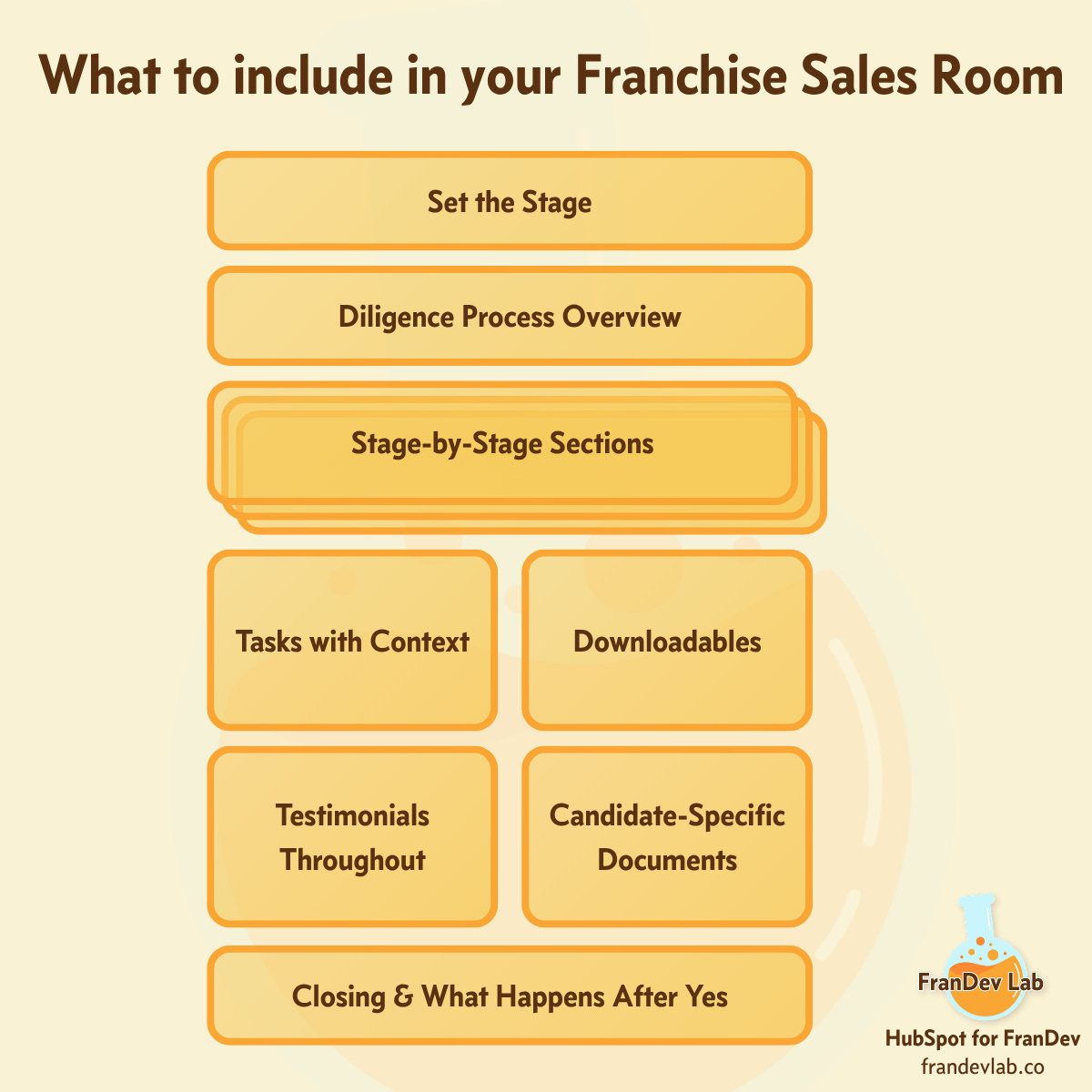
1. Welcome / How to Use This Room
Orient the Candidate and cut friction. A short welcome video, an overview of what’s inside, and a clear “do this first.” Within thirty seconds they should know what kind of room they’re in and what to do next. Add some hype here too — show them why people love your brand. Your Brand content lives in this section.
2. Process Overview
Give them an overview of the whole journey up front so they always know where they are. Lay out each stage, how long it takes, and what it’s for. This is where you demonstrate that your diligence process is an actual process, not just a stumbling series of calls.
3. Stage-by-Stage Sections
One section per stage — the next level of detail below the overview. Name the stage, its major activities, the materials and assets it includes (workbooks, recommended lenders, manuals), and the questions it answers. Don’t just say you run a Territory call. Tell them: “When the Territory stage is done, you’ll know whether your target market fits our brand and you’ll have the exact definition of the territory you’d buy.”
4. Candidate-Specific Documents
One home for the documents that belong to this Candidate: their Territory definition, their FDD when appropriate, custom financial or validation packets, recap notes tied to milestones. Easy to find, easy to share with a spouse or advisor. No more “its in your email”.
5. Tasks and Action Items (with Context)
Explicit next steps, paired with the why. A “Why this matters” explanation with each task, links to supporting resources, etc. You tell them on calls you want them to have a Franchise Attorney review the FDD and the Franchise Agreement. That’s great, but include in the Sales Room task additional context. Each task should explain the what, they why, and the outcome.
6. Testimonials and Proof Threaded Throughout
A lot of Brands add a Testimonials section to their website and Sales Rooms. That’s a great way to make sure no one sees your best assets. These doesn’t belong somewhere Candidates need to seek them out. Thread them throughout the room, next to the stage it speaks to: customer and Franchisee testimonials, “a day in the life” clips, “what I wish I knew” snippets, short videos from your Directors and coaches. Each one reconnects the Candidate to the why right when they need it.
7. Downloadables / Asset Library
A single home for the evergreen resources a Candidate uses on their own time: one-pagers, comparison checklists, market data sheets. Worth adding: an AI Diligence Packet, a curated bundle a Candidate can feed into ChatGPT or Claude. If they’re going to run your brand through AI anyway, hand them clean source material and shape what those tools tell them.
8. Closing / What Happens After “Yes”
Confirm expectations and take the fear out of the last mile: signing expectations, the commitment window, Discovery Day follow-up, a preview of onboarding. Signing the FA isn’t the last step — it’s the first step toward becoming an Owner. When you extend an offer, drop the signing link here and move it to the top of the room.
So…now what?
If you have a Sales Room, pull up the template and review it against these eight sections. Find the weakest one and fix it this week. If you don’t, drop me a line and we’ll look at what’s possible.